

In 2025, competitive funding disbursed to Investing in America (IIA)1 projects fell 30% even as the number of active grants held flat.2 Same number of projects on the books. Less money out the door.
The gap between what’s been promised and what’s been delivered is the defining story of the Trump administration’s efforts to undermine $630 billion in federal commitments.3 In my first post I introduced the Investing in America Funding Tracker and showed that one in four committed dollars has either been canceled or is at risk.4 But cancellations account for just $28.3 billion — less than 5% of obligated funding. The vast majority of jeopardized funding, 5 $129 billion, is frozen or otherwise held up through administrative inaction, without ever being formally terminated.
A Pillow, Not a Chainsaw
In March 2025, Elon Musk took the stage at CPAC wielding a chainsaw, vowing to cut federal spending. Musk’s Department of Government Efficiency (DOGE) did take this approach to the civil service. But the administration has taken a quieter approach to undermining federal investments – less a chainsaw than a slow suffocation. And that effort has been guided by a structural distinction in the funding itself.
Formula programs account for $342 billion in IIA funding, distributed to states by statutory criteria (e.g., population, road miles, water infrastructure needs), which leaves agencies little discretion over where the money goes or how it’s used. Competitive programs account for $288 billion in obligated funding and work differently. Agencies define selection criteria, set programmatic requirements, and choose grantees.6 That flexibility allowed agencies to take a strategic approach to funding that prioritized good jobs, equitable outcomes, and climate-related goals. But it also made these programs targets for the Trump administration.
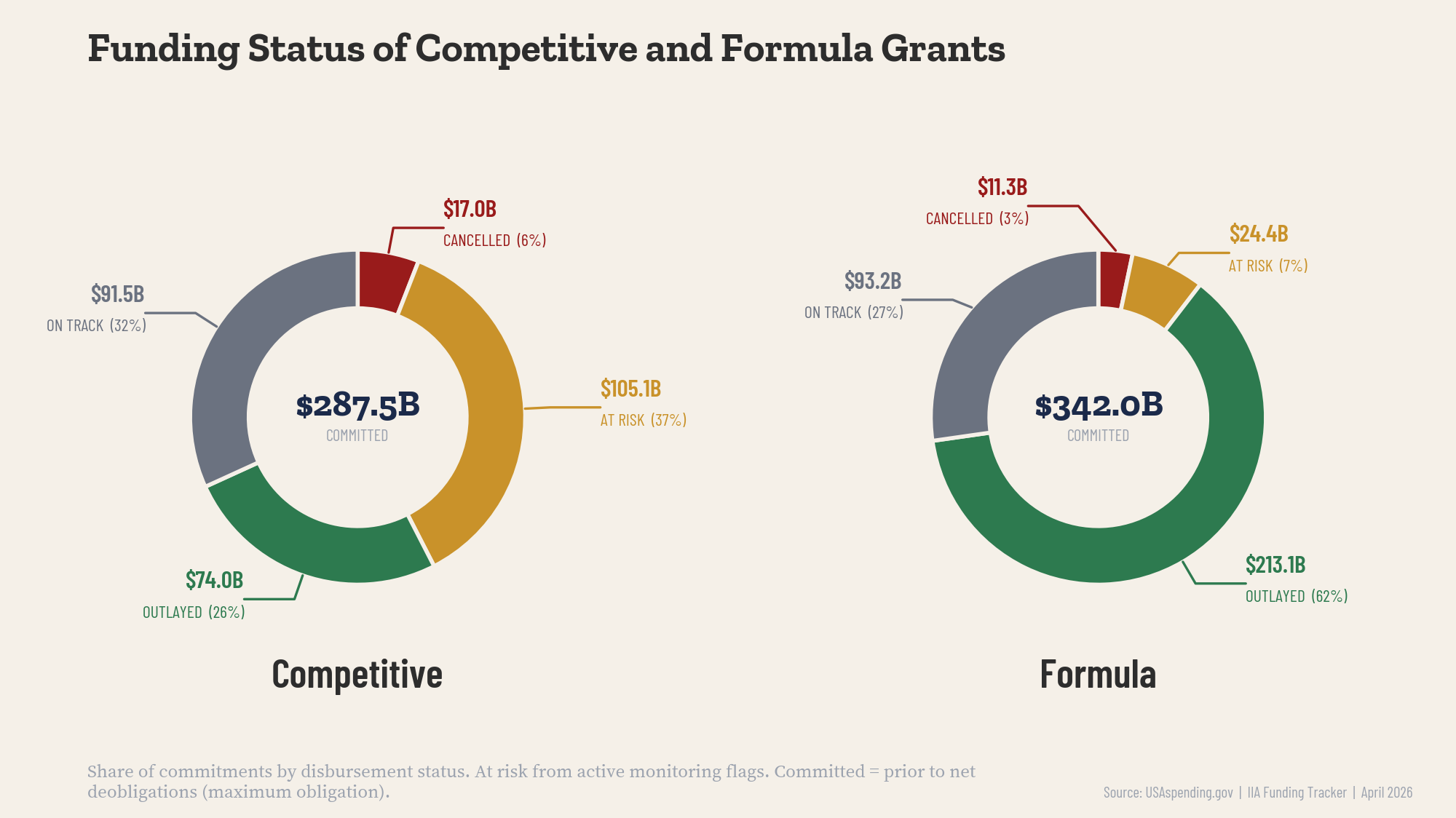
The administration has let formula funding flow — 80% of remaining funding is on track to reach projects — while smothering competitive programs, where less than half is.
The Squeeze
The clearest evidence shows up in outlays — the dollars actually disbursed to projects.
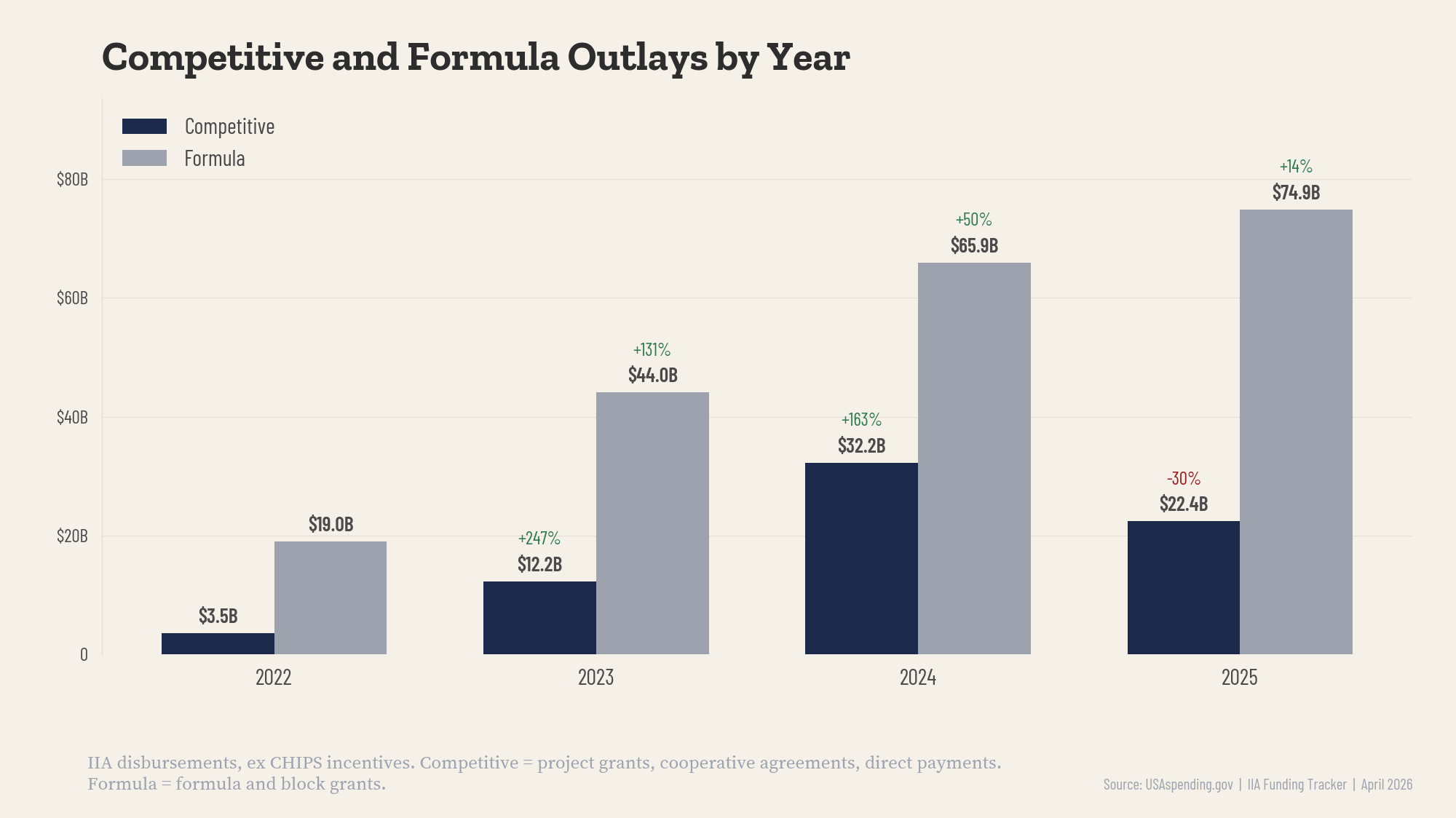
Outlays to competitive projects fell 30% in 2025 while the number of active projects barely moved (-2.1%) and formula outlays kept growing (+14%). That divergence is the tell. Normally, competitive outlays ramp up: slow in the early phases as grantees work through planning, procurement, and permitting, then accelerating as projects move into construction and grantees seek reimbursement. Formula funds, by contrast, often flow straight to recipients in consistent chunks. The 2022–2024 cohorts of competitive grants are now several years in — exactly the stage when outlays should be greatest. Instead, they collapsed.
The drop-off is consistent with suffocating these projects through inaction rather than formal cancellation. Cancellations trigger notice and appeal rights for grantees and administrative burden for agencies; inaction, however, can kill projects without any process. A recent report from the Department of Energy (DOE) Alumni Network documented agencies systematically “ghosting” grantees — sitting on invoices, ignoring calls, leaving projects in funded limbo. No termination letter. No press release. Just silence.
The data bears this out.7 Cancellations of competitive grants grew from $2.5 billion in 2024 to $11.4 billion in 2025, and are pacing toward $3.6 billion in 2026. But at risk funding, driven by frozen funds, exploded over the same period — from $5.9 billion to $21.6 billion — and has hit $32.6 billion in the first two months of 2026 alone.8
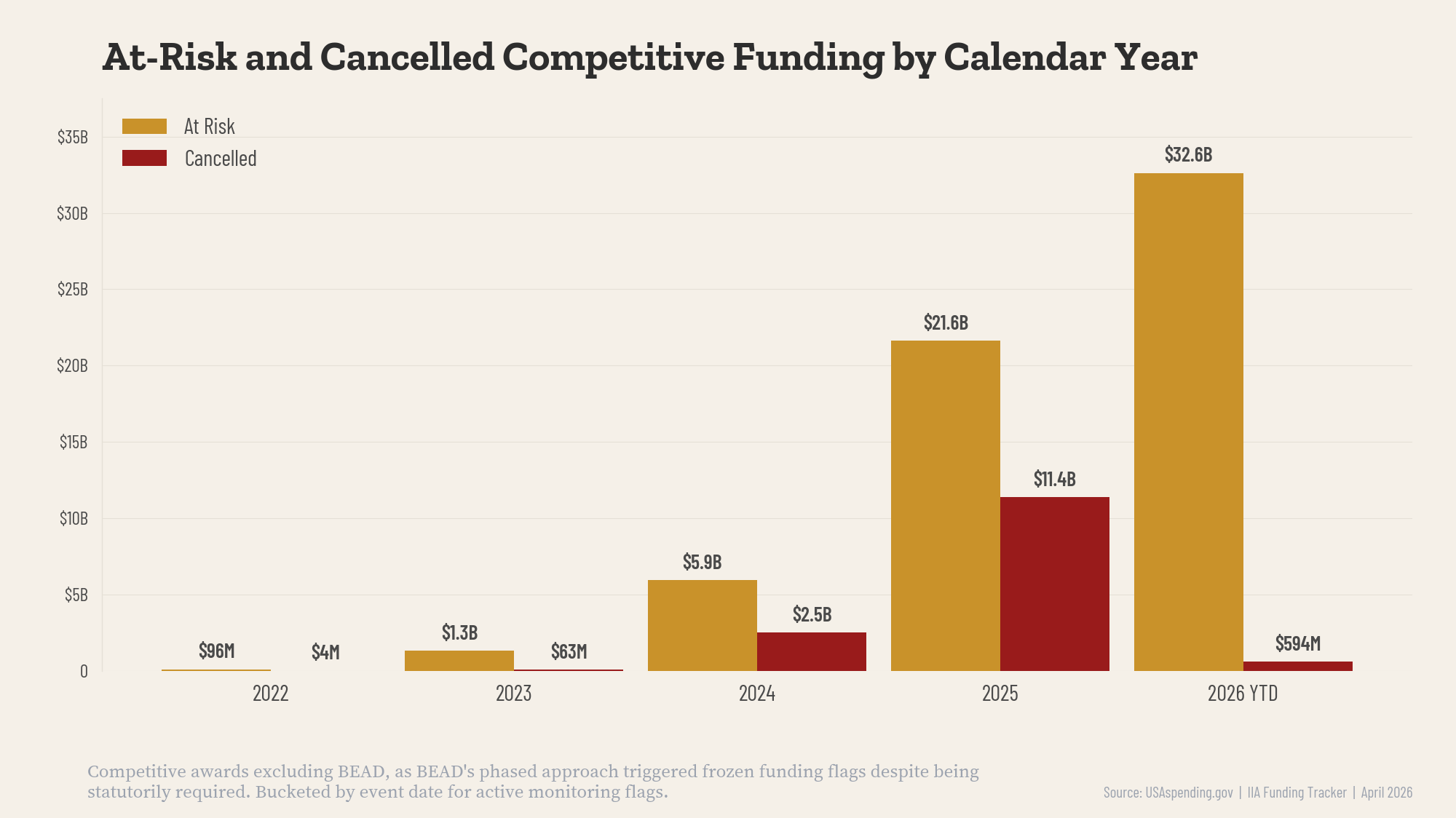
This divergence isn’t incidental. Competitive programs funded the bulk of the Investing in America projects you’ve read about — clean energy, semiconductor manufacturing, grid modernization, broadband expansion — and carried the policy ambitions that came with them.
Under Pressure
From day one, the Trump administration targeted diversity and equity, good jobs, and climate action. Then it turned to the competitive programs that had embedded those priorities most deeply. The pattern was most clear at DOE, which required many grant applicants to submit community benefits plans covering workforce standards, equitable hiring, and efforts to engage local communities.
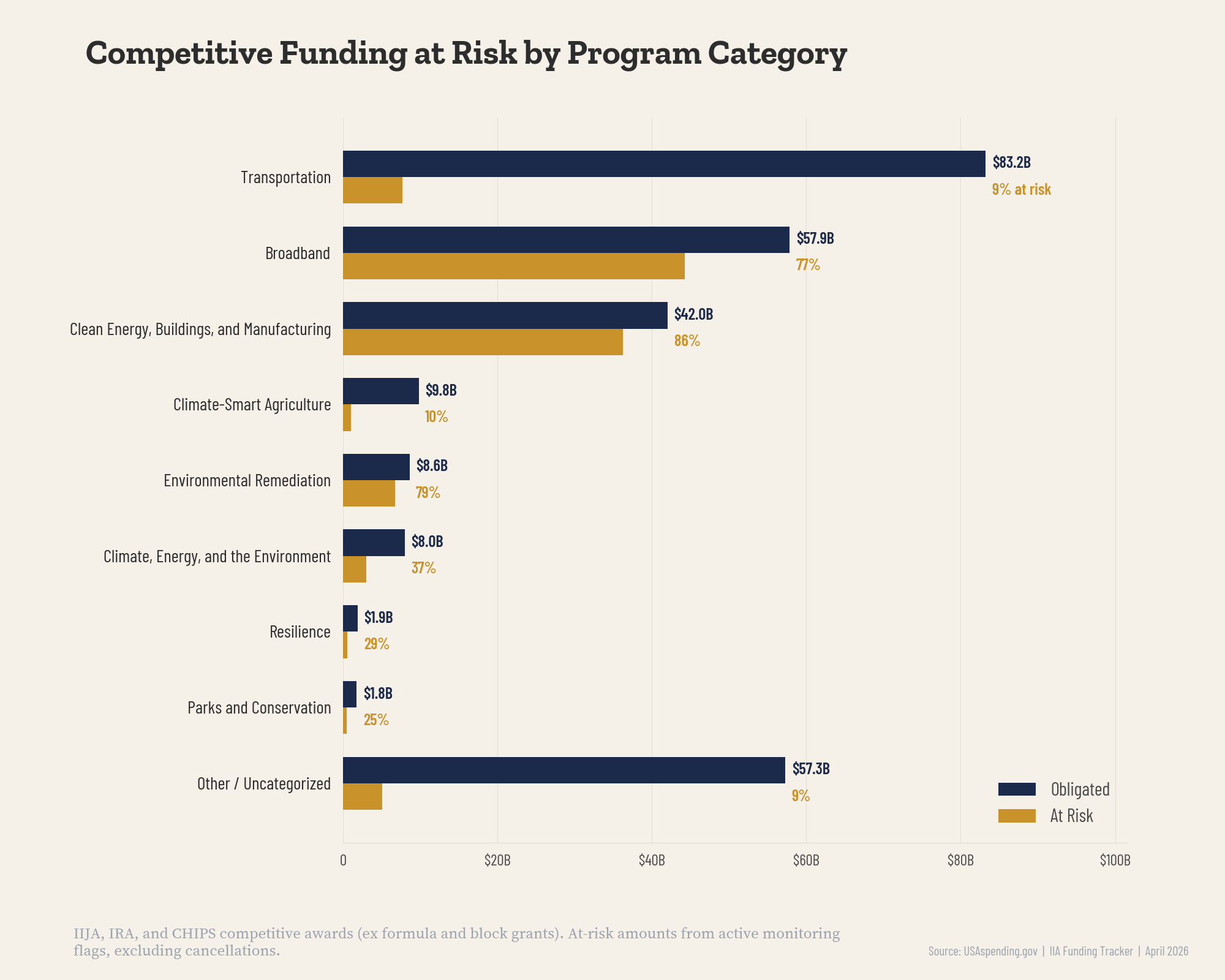
More than three-quarters of competitive funding for clean energy, buildings, manufacturing, and environmental remediation is in jeopardy. These programs would be especially valuable right now, as Americans contend with rising energy costs driven by surging data center demand and a war of choice with Iran that has reminded the world that fossil fuel dependence threatens national and economic security as much as the climate.
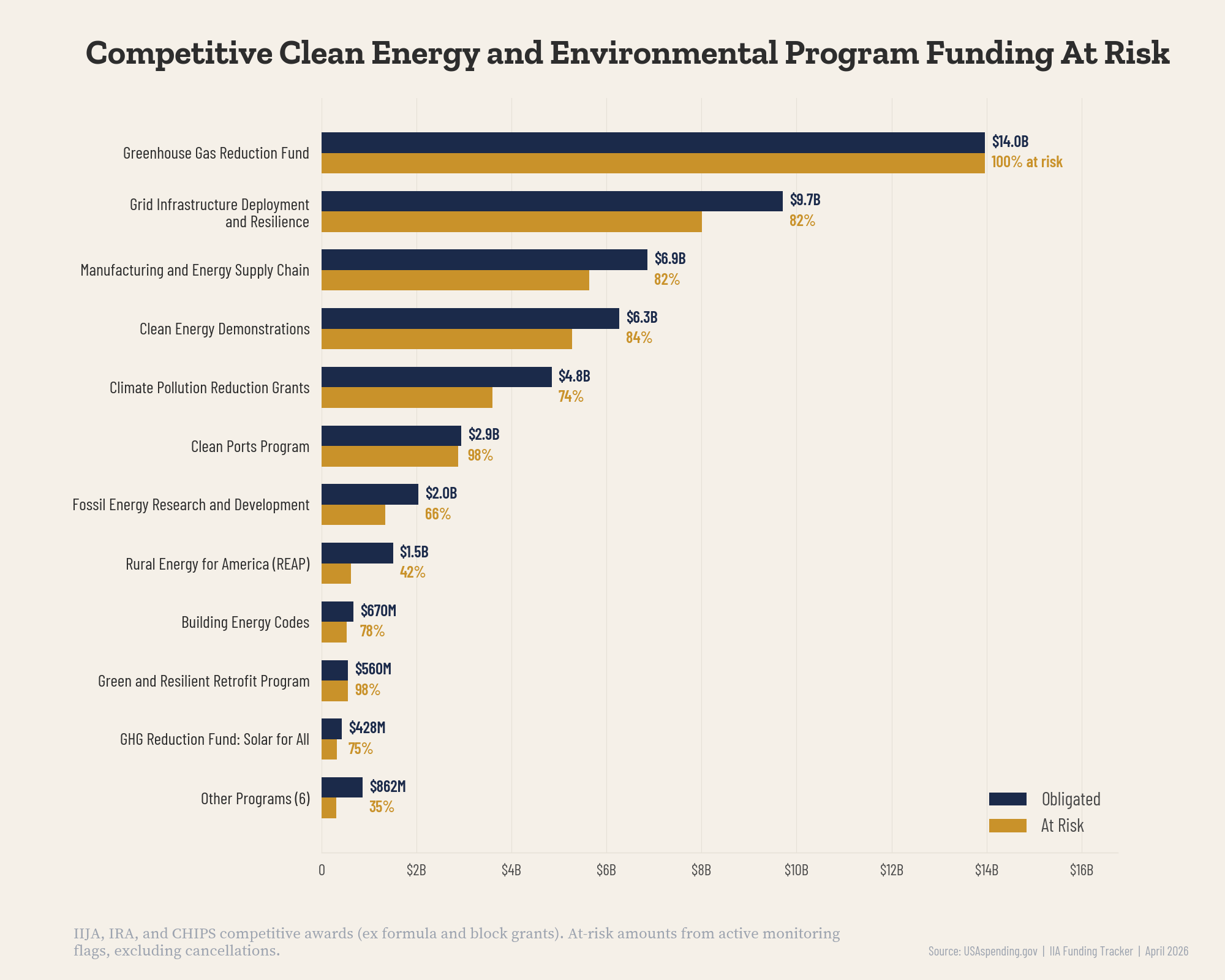
One of the largest targets is the Greenhouse Gas Reduction Fund, where the administration is trying to claw back $14 billion. But the freeze extends across many programs:
Grid infrastructure deployment and resilience programs modernize America’s power grid to lower energy costs and improve reliability ($8.0 billion at risk, representing 82% of program funding).
Clean energy demonstration programs fund large-scale pilots of next-generation technologies like advanced nuclear and long-duration storage ($5.3 billion at risk, 84% of program funding).
Manufacturing and energy supply chain programs build domestic factories and supply chains and cut U.S. dependence on foreign energy ($5.6 billion at risk, 82% of program funding).
These programs were designed for the long haul. But the problems they address are arriving now, even if the money isn’t.
The administration isn’t just smothering energy projects. Of the $43.7 billion the Broadband Equity Access and Deployment (BEAD) program has obligated to states, only $2.4 million has reached communities.9 The administration delayed implementation by rewriting program guidance — stripping labor protections and changing how funds are allocated — which is expected to leave $21 billion unspent and a million locations unserved.
The Ripple Effect
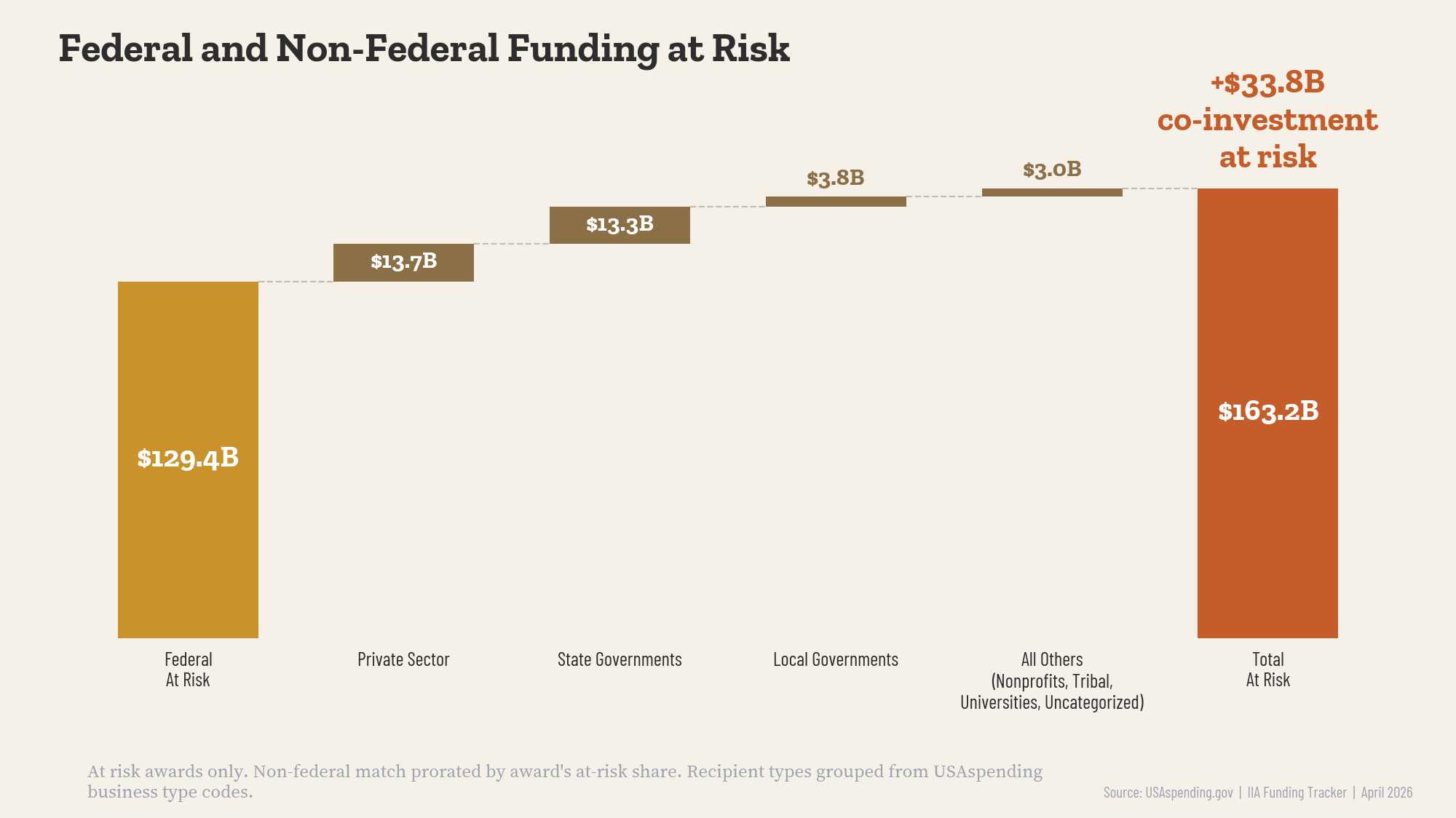
The federal dollars at risk are only part of the picture. Many grants require recipients to put up matching funds, and when the federal share freezes, that co-investment is jeopardized too. For every $1 of federal funding at risk, an additional $0.26 in non-federal funds is on the line.10
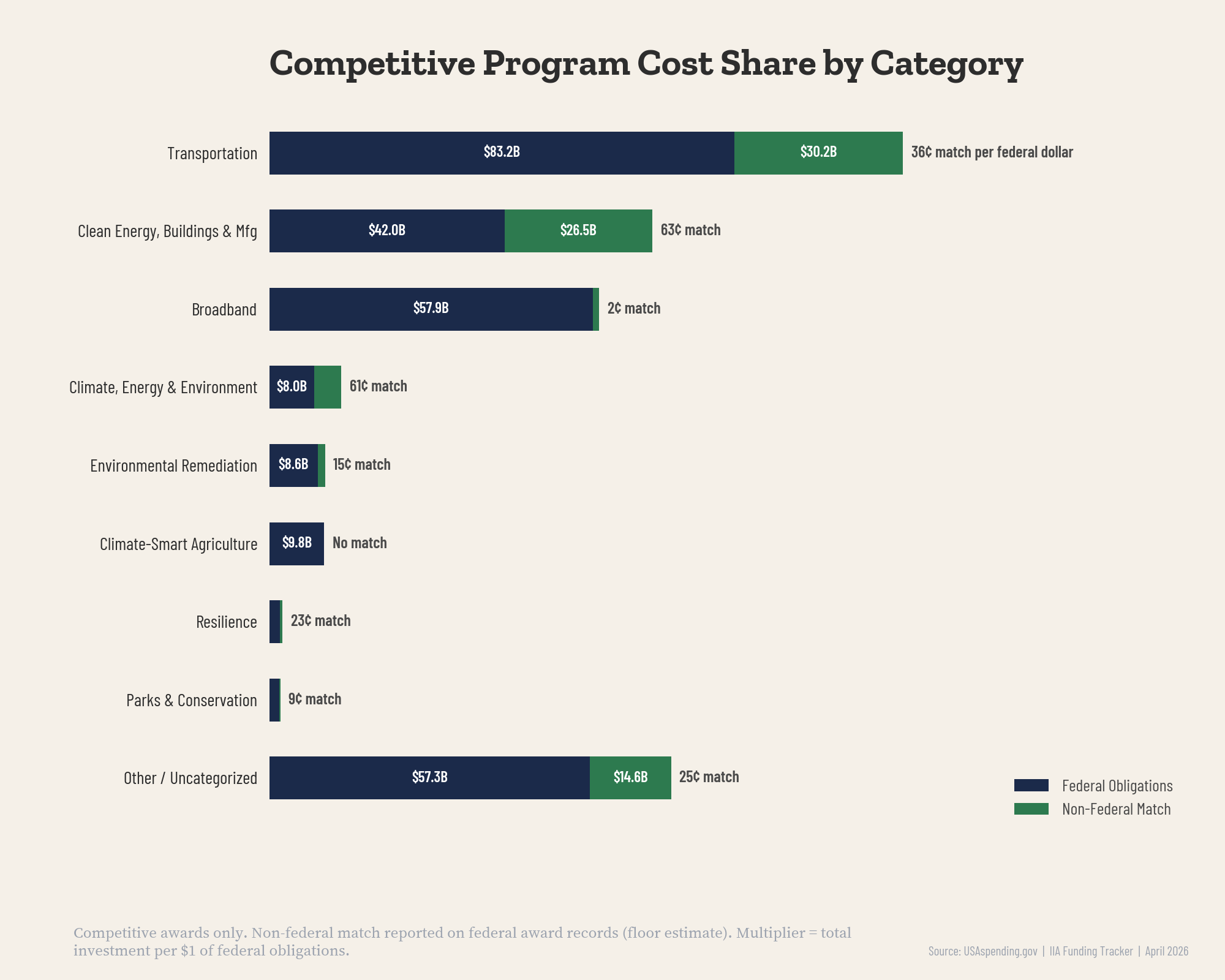
And the cost-share ratio is far higher in the competitive programs being targeted — clean energy, buildings, and manufacturing recipients are investing $0.63 for every federal dollar. The administration has concentrated its efforts where the economic multipliers, and the lost opportunities, are greatest.
The $329 Billion Opportunity
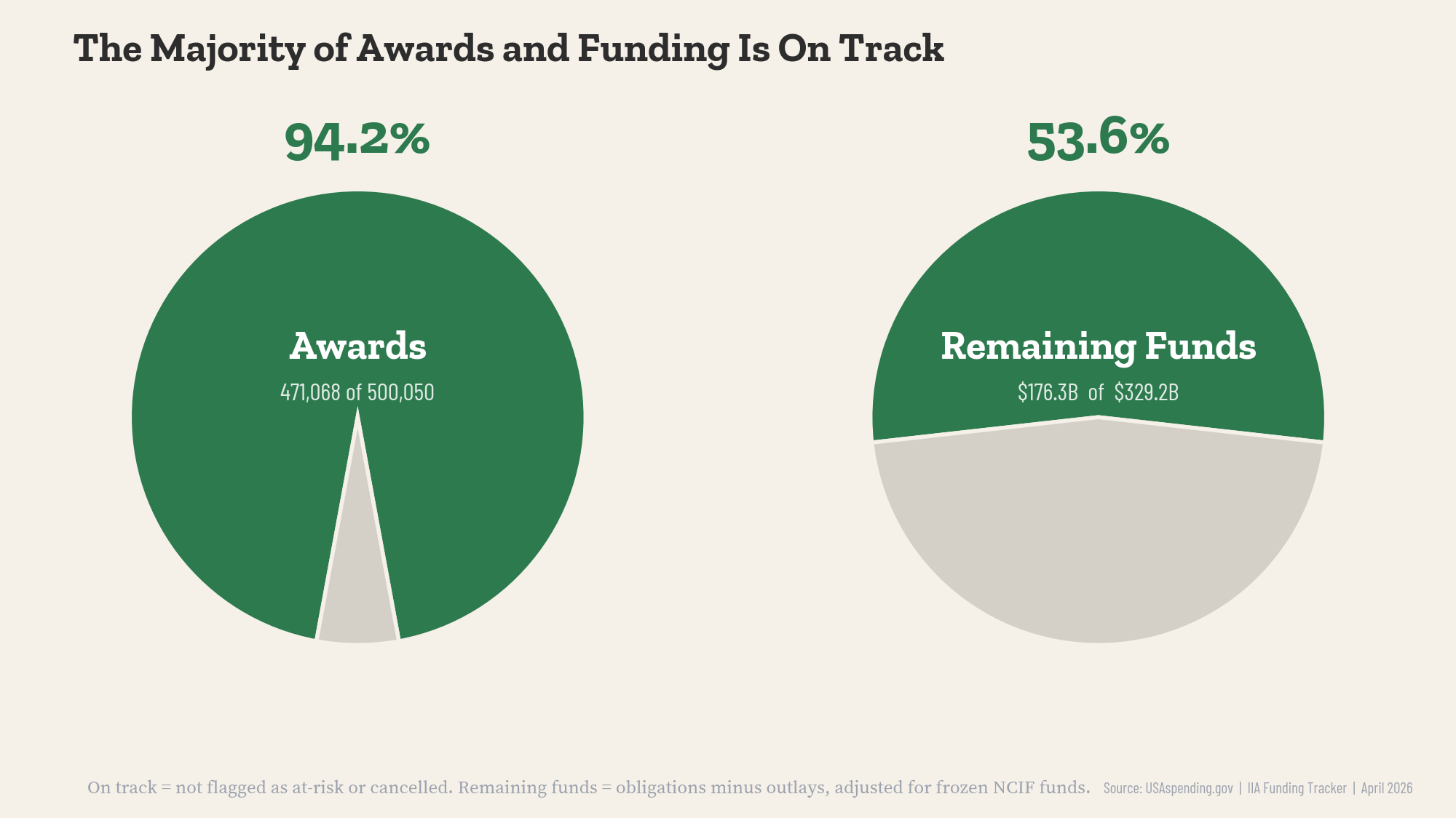
Even so, $329 billion in obligated formula and competitive funding remains unspent — more than all federal contracts, grants, and loans made through the 2009 Great Recession stimulus. The administration’s efforts have focused on a relatively small number of high-value projects but 94.2% of awards are proceeding normally and $176 billion of funding is still on track.11 Grant recipients can and should still use this money to create good jobs, invest in workforce development, and expand equitable opportunities. Many will keep doing so because it’s good business: they need to attract and retain skilled labor and build a pipeline of qualified workers. But labor unions, community-based organizations, and state and local governments have a critical role in shaping how these funds are implemented, and can use the Investing in America Tracker to focus their efforts on the projects that are moving forward.
The $129 billion in at risk funding has proven more resilient than the administration expected. Obligated funds are hard to cancel without cause, and grantees have pushed back hard. When DOE announced the termination of over 200 grants during the October 2025 shutdown, hundreds disputed their terminations and six won in court, paving the way for others. As of March 2026, 198 lawsuits have been filed challenging grant terminations or withheld funds, many successfully.
But court victories only go so far. The Supreme Court’s ruling against nationwide injunctions forces each grantee to litigate individually — a process that can take years. Advocacy and congressional action will ultimately be needed to unfreeze these funds, which is why the 2026 midterms are an inflection point. $129 billion in federal investments are at stake in communities across the country, and voters deserve to know what’s on the line. The Investing in America Tracker now generates printable fact sheets for any state, county, or congressional district — showing what was promised, what’s been delivered, and what’s in jeopardy.
For example, the fact sheet for Michigan’s 7th district (which includes Lansing) shows $2.2 billion at risk — including a $500 million grant to convert a General Motors factory to produce electric vehicles.
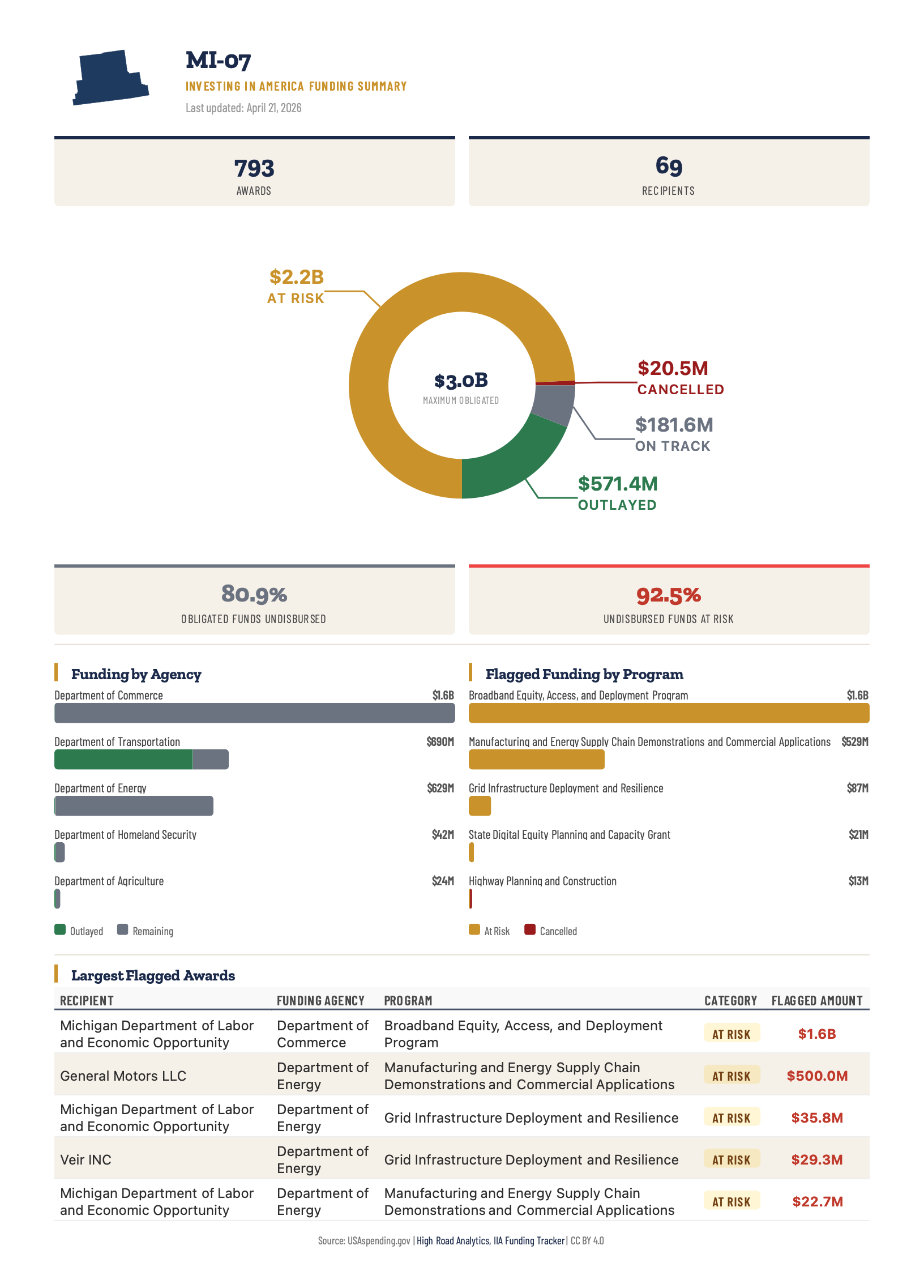
My next post follows the money around the country — which districts have the most at stake, and where frozen projects could tip races come November.
Questions, feedback, or press inquiries? Reach me at emlynbottomley91@gmail.com.
Investing in America refers to the Infrastructure Investment and Jobs Act (IIJA), the Inflation Reduction Act (IRA), and the CHIPS and Science Act (CHIPS).
Active competitive grants remained largely stable year over year, with a modest 2.1% decline driven by a 68% drop in new competitive awards made in 2025.
$630 billion is the maximum or full value of obligations made under IIA prior to any net deobligations or cancellations.
Cancellations refers to net deobligations (reductions in obligations) as reported by Treasury File C data. At risk refers to funds flagged due to one of four triggers: frozen funding (e.g., minimal outlays on significant obligations), significant unspent funds after the end of the project’s period of performance , significantly shortened project timelines, or manual review. About 88% of at risk funds are flagged due to frozen funding. See https://iiatracker.highroadanalytics.org/about for detailed information about the methodology.
Jeopardized funding refers to funding that has either been deobligated or flagged as at risk.
Agency discretion is still subject to statutory requirements and the Office of Management and Budget’s (OMB) Uniform Guidance.
The at risk analysis excludes Broadband Equity, Access, and Deployment (BEAD). BEAD’s statutorily required phased approach delayed funding for more than a year — past the at risk trigger point — so a straight application of the trigger would mislabel the program. Subsequent Trump administration actions have further delayed and jeopardized BEAD funds, which is why the IIA Funding Tracker considers BEAD as at risk.
Treasury and USASpending.gov data typically lag by about a month. This analysis uses data through February 2026.
$43.7 billion represents the maximum commitment for BEAD. $2.1 billion has already been canceled bringing current obligations to $41.6 billion.
This is almost certainly an underestimate. Grant analysts don’t always enter matching funds into grants reporting systems, and matching funds aren’t available on USAspending.gov for large CHIPS investments where companies provided substantial co-investment.
On track refers to awards and funding that have not been flagged as at risk or canceled.